

A brain-computer interface (BCI) is a device that connects the human brain directly to a computer, allowing thoughts to control digital systems. While this sounds like the plot of a futuristic novel, it is an emerging reality with profound medical implications. Elon Musk’s company, Neuralink, has already successfully implanted such a device in a human subject, Noland Arbaugh, who regained digital control after paralysis.
Key Takeaways from Brain-Computer Interface Technology
- Direct Neural Control: BCIs create a direct link between the human brain and computers, allowing individuals to control digital systems and devices using only their thoughts.
- Medical Breakthroughs: This technology is primarily aimed at restoring independence for people with paralysis, ALS, and limb loss, enabling them to operate cursors, robotic limbs, and smartphones.
- Proven Human Success: Real-world applications, such as Noland Arbaugh’s Neuralink implant, have shown that patients can achieve record-breaking speed in digital control and perform tasks like playing chess or video games.
- Diverse Technological Approaches: The industry is split between high-precision invasive implants (like Neuralink) and safer, non-invasive wearables (like Neurable) for consumer use in gaming and mental health.
- Significant Ethical Hurdles: While revolutionary, the field must navigate serious concerns regarding surgical risks, the privacy of brain data, and the long-term impact of implants on brain tissue.
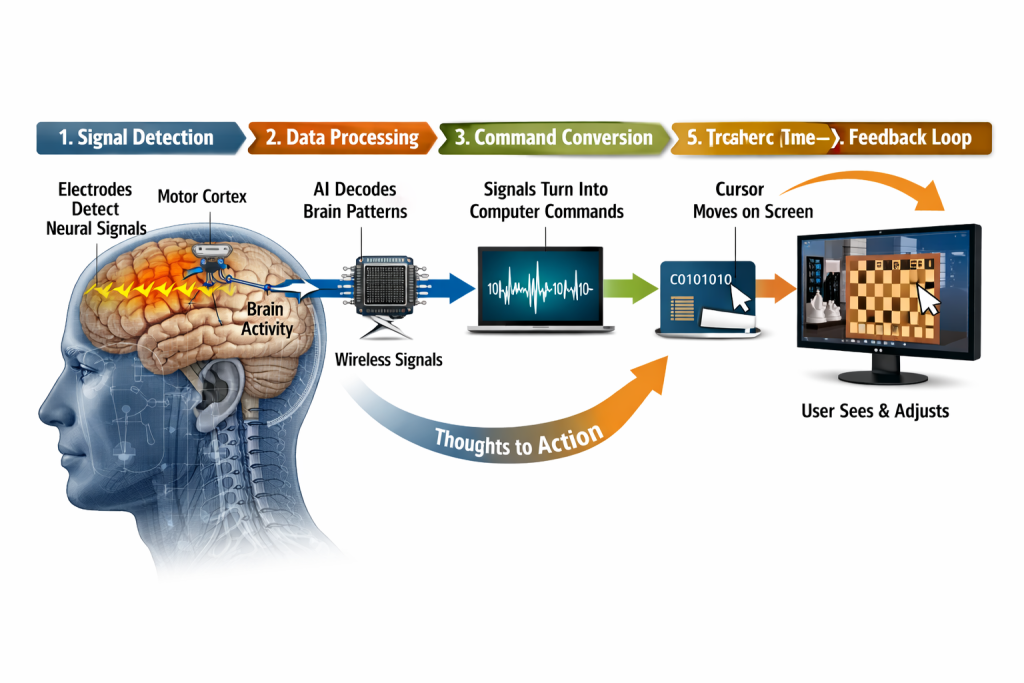
How a BCI Works in Simple Terms
At its core, a BCI reads electrical signals from the brain and translates them into commands a computer can understand. Tiny electrodes are placed on or inside the brain to detect neural activity. Software then interprets these signals to move a cursor, type text, or control external devices. The primary goal is to help people with paralysis, neurological disorders, or limb loss regain independence by controlling technology through thought alone.
Neuralink’s Specific Approach
Founded by Elon Musk in 2016, Neuralink uses a coin-sized implant containing over 1,000 electrodes. These monitor neurons in the motor cortex, which is the area of the brain responsible for movement.
- Wireless Connection: The implant sends signals to a computer or phone via technology similar to Bluetooth.
- Precision Surgery: A specialised robot inserts the electrodes to minimise damage to brain tissue.
- The Translation Process: The implant detects tiny voltage changes when neurons fire. Artificial intelligence (AI) learns to recognise patterns in this activity, such as the intent to move a hand. Once identified, the AI converts the pattern into a digital command that the connected device executes instantly.
A Success Story: Noland Arbaugh
Noland Arbaugh, who was paralysed from the shoulders down following a diving accident, received a Neuralink implant in late 2024.
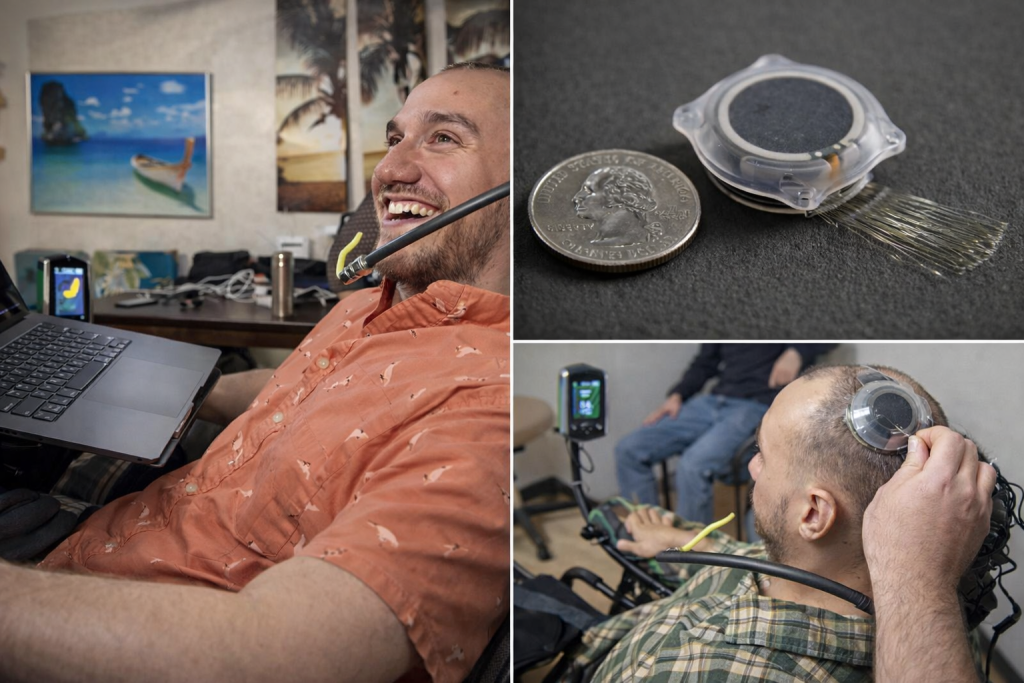
Arbaugh works with Neuralink developers and engineers to learn and improve the implant’s operation.
The coin-sized Neuralink implant contains a small battery, advanced low-power chips and 64 threads containing 1024 electrodes.
A wireless charger is used to recharge the implant battery.
Photo/captions credit newmobility.com
Within days, he could move a computer cursor, play chess, and play video games using only his thoughts. Arbaugh described the experience as life-changing, noting that it restored a sense of freedom and set a BCI speed record for thought-controlled cursor movement.
The Competitive Landscape of Neurotechnology
Neuralink is part of a broader movement, with several major companies developing BCIs:
| Company | Technology Focus | Key Achievement or Goal |
| Synchron | Minimally invasive implant inserted via blood vessels. | First U.S. company to implant a BCI without removing skull tissue. |
| Precision Neuroscience | Ultra-thin flexible electrode film placed on the brain surface. | Aims for safer, reversible implants for clinical use. |
| Blackrock Neurotech | Long-established electrode arrays for motor and sensory restoration. | Over 30 human implants since 2004. |
| Neurable | Non-invasive EEG headset for consumer applications. | Allows users to control virtual environments in gaming. |
Comparing Invasive and Non-Invasive Technology
BCI technology is generally split into two categories:
- Invasive BCIs: These require electrodes to be surgically implanted directly into or onto brain tissue. They offer very high signal quality and precision, making them suitable for fine motor control. However, they carry surgical risks and may degrade over time.
- Non-Invasive BCIs: These use sensors placed on the scalp to detect activity through the skull. While completely safe and requiring no surgery, the signals are weaker and less precise. These are typically used for gaming, mental health tracking, or basic device control.
Ethical Considerations and the Future
Despite the promise of treating conditions like ALS and stroke, the field faces significant concerns. These include the physical risks of brain surgery, the potential for brain data privacy breaches, and criticism regarding early animal testing.
As of early 2026, 21 patients had received Neuralink implants following FDA approval for human trials in 2023. The long-term goal is to make BCIs as common and user-friendly as smartphones, potentially restoring sight, hearing, or even memory in the years to come.
No Comments